Showing posts with label Technology in the classroom. Show all posts

Saturday, January 19, 2019

How to W.I.N. in the Classroom: Station Ideas


W.I.N. Block math station ideas for the elementary classroom from Literacy Loves Company.


My favorite part of organizing my W.I.N. rotations is figuring out what I will have students work on at each station.  When planning for station activities, I am always looking at three things:
1.  Does the activity meet students' needs in the area we are working on?
2.  Is the activity fun yet rigorous?
3.  Is the activity easy to organize, understand, and clean up so that students are able to work at it independently?  This is going to look very different depending on what grade you teach.  

In my class I run five to six math stations at a time, depending on how many student groups I have.    

Teacher Time
As mentioned in the second post in this series, I always start my planning with the Teacher Time station.  I've heard this station called many things, but it is basically the station in which you, the teacher, meet with a small group of students for direct instruction.  The focus should be whatever caused you, while looking at your data, to group these students together.  I am currently scoring a set of post assessments for my math students.  While I am looking over their papers, I am keeping a list of students who struggled in each of the areas covered on the test.  When I plan for my next round of stations, I will group my students based on the needs I noticed and focus my lesson on that skill, strategy, or concept.  

Tech Time (iReady)
During Tech Time, my students work on iReady.  This is software that provides students with individualized lessons and practice based on a beginning of the year diagnostic.  My school is lucky to have this resource, and I know that not all schools do.  There are several free online math resources that are available for students.  Some examples are MobyMax and Khan Academy  Two game based websites are Prodigy and Skoolbo.  I have used MobyMax, Khan Academy, and Prodigy in my own classroom.  My students LOVE prodigy and will even ask to stay in at recess to play it.  

Number Corner
Because my school uses the Bridges curriculum, it comes with another component called Number Corner.  It is probably similar to a calendar time you would see in a primary classroom.  I have never taught primary, so I'm hoping this is an accurate assumption.  During number corner, students are working on finding patterns on calendar markers, working with problem solving and computation, fact fluency, and measurement among other things.  

Game Time
Game time is a great opportunity to focus students on different skills and concepts.  Games can be geared toward what you are working on in class or you can easily differentiate for each group that comes to that station.  For example, my students just finished a unit on fractions.  After looking through their assessments and organizing groups, I can easily have game kits ready for groups who are working on adding fractions, another for students who need review with equivalent fractions, and still another for students who are struggled with common denominators. 
Targeted Skill Time
There is always a skill I would like my students to get more practice with.  During this station, I focus on one skill and then differentiate within that skill.  This is one of the few stations that I use worksheets in.  At the beginning of the school year I invested in a subscription to Math Worksheets 4 Kids.   I have found this website to be very helpful.  I am able to look up worksheets my concept and then find worksheets by level.  Another great website is commoncoresheets.com .  Other options for this station are task cards or task mats.  If you can find ones that are self-check, that is a bonus!
W.I.N. Block math station ideas for the elementary classroom from Literacy Loves Company.
Measurement Task Mats available @ Literacy Loves Company on TpT.  Click on pic for more information.

Geometry
Geometry seems to always be the last unit of the curriculum and the hardest to get to.  Because of this, I have a geometry station.  I use my math curriculum and the state standards to guide this station.  My goal is to give students an opportunity to work with these concepts before state testing in May.
W.I.N. Block math station ideas for the elementary classroom from Literacy Loves Company.


The above stations are the ones I currently have in my W.I.N. rotation.  Some other ideas for stations are:
Fact Fluency - Practice math facts - This station would be easy to differentiate as student work on the facts they have yet to master.  This station could be as easy as flash cards and timers as student work to be able to quickly recall their math facts.

Mathematical Picture Books - Sometimes reading a picture book based on a math concept can be a great way for students to connect.  There are a lot of wonderful picture books available depending on what you are focusing on in class.  For this station, you could have a picture book focusing on the concept you are teaching in class.  Inside the book, you could ask discussion questions on sticky-notes strategically placed throughout the book.  As students read, they stop to answer and discuss your question.  Depending on the book, you could add an extension task.

Math Art - Integrating art into your math stations can really motivate students to participate.  When working with area, symmetry, plane figures, angles, and more.  The activity featured below is from a blog post I wrote a few years ago.
W.I.N. Block math station ideas for the elementary classroom from Literacy Loves Company.

As you can see, there are MANY ways you can support students in stations during your W.I.N. block.  The thing to keep in mind is that whatever task you are asking your students to participate in, it is one that will move them forward and help them be successful.

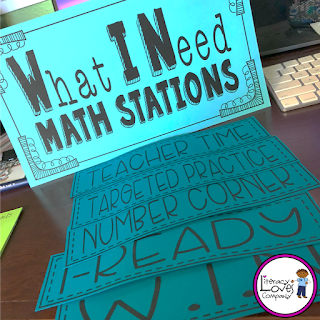
Once you decide on what stations would best benefit your students, try to find a space on a classroom wall, blackboard, or whiteboard to host your W.I.N. Station rotation board.  This is the area you will post your station signs and student names.  Click below for a free download of the station headers and sign. There are two options:  Google Slideshow which is easily editable or PNGs which can be printed as is or placed in a PowerPoint slideshow and edited.


W.I.N. Block math station ideas for the elementary classroom from Literacy Loves Company.


W.I.N. Block math station ideas for the elementary classroom from Literacy Loves Company.

I have my W.I.N. board located on a blackboard.  My signs all have magnetic tape on the back which makes it easy to move.  At the end of each day, I move my station headers to the left, rather than move the student names.

As you can see, coming up with ideas for your W.I.N. stations isn't difficult!  There are a plethora of options available to you.  If you have a great idea for a math station that wasn't mentioned in this post, please share it in the comments below.

In my next post in this series, I will be sharing with you ideas for organizing and managing your teacher paperwork and your station materials.

•   What is W.I.N.?  - free download of "What is W.I.N. Time?" and "Expectations" posters.
•   Organizing Student Groups - Free download of Group Organization tool
•   Station Ideas - free download of editable station signs and group headers
•   Managing Materials - free download of binder cover and spine
•   Keeping Kids Accountable - free download of student recording sheet
•   Launching a W.I.N. Block - Mystery download!


FREEBIE

W.I.N. Block math station ideas for the elementary classroom from Literacy Loves Company.
Domino Fractions FREEBIE.  Click on image.  

  I'm always adding products, free and paid, so please follow Literacy Loves Company on TpT so that you get notification.  I price all of my newly added paid resources at 50% of for 48 hours, so it is a great way to save money. 

Thanks for visiting Literacy Loves Company!  

signature-fonts


Sunday, May 29, 2016

Classroom DIY: Pioneer Journals

Are you looking for a meaningful way to integrate writing in your social studies classroom?  Try historical journals!  A great way to integrate narrative writing and history!

If you are anything like me, you are always in search of ways to keep your writers writing.  When I can integrate writing with another subject area, it is a win-win!  During our study of pioneer and The Oregon Trail, pioneer journals are fun way for students to use their creative brains, practice their narrative writing, and share what they are learning with others!
Are you looking for a meaningful way to integrate writing in your social studies classroom?  Try historical journals!  A great way to integrate narrative writing and history!
Every year, the fourth graders at my school participate in an Oregon Trail simulation.  Students are grouped in wagon trains groups, select a wagon master to lead them on their journey to Oregon, and buy supplies.
Are you looking for a meaningful way to integrate writing in your social studies classroom?  Try historical journals!  A great way to integrate narrative writing and history!

Wagon trains earn points which help them move along the trail.  As they move across the Oregon Trail map, they learn about the landforms, native people, and the dangers pioneers faced as they made the treacherous journey.

One of the ways students document their trials and tribulations along the trail is by writing in their pioneer journals.  This is a great way for students to practice narrative writing while learning about a history!

Before my students make their journals, we talk about how important the journals of the pioneers are to preserving history.  Much of what we know about pioneer life and the trip west we know because of these primary documents.   After that introduction, we get busy making our journals!


The materials you will need for making the journals are pretty easy to come by.

Are you looking for a meaningful way to integrate writing in your social studies classroom?  Try historical journals!  A great way to integrate narrative writing and history!
You will need a large paper bag for each student.  I just had students bring them from home.  You will also need yarn or twine, masking tape, a heavy duty hole punch.  An electric hole punch would work the best, but I have a two hole punch at school that I used.  It is heavy duty and works great!  My three hole punch works well too.  You'll see a picture of it a bit later.  The one shown above DOES NOT work well.  I'm not sure why I added it to the photo.  :)   For the journals you will also need either lined or unlined paper.  I gave my students a choice.  Each student will need 10 - 15 pages.

At some point, you will need your students' pioneer portraits.  On the day my class was building their journals, we held our photo shoot.  I photo edited (more on how to do this later in the post) and had the photos printed over the weekend so that we could finish our journals the next week.

The first thing your students will need to do is cut the bottom out of their bag.  Using a good pair of scissors, model for them how to cut down one corner crease and then around the bottom section of the bag.  When you are done, you will have one large section.  If your bags have handles, they can be used for a latch which I'll explain later.  

Are you looking for a meaningful way to integrate writing in your social studies classroom?  Try historical journals!  A great way to integrate narrative writing and history!
 Now for the fun (and LOUD) part!  In order to soften up the paper and make it easer to work with (and make it look and feel more like real rawhide) students will need to work their paper.  This means they will need to crinkle it up and smooth it out over and over and over and over and over again!  The more they work their paper, the more it breaks down the paper fibers and it gets softer and softer. This gets noisy!  I suggest having students carefully roll it up and then step on it, putting as much weight as possible.  They will need to be careful though.  The paper will rip pretty easily.
Are you looking for a meaningful way to integrate writing in your social studies classroom?  Try historical journals!  A great way to integrate narrative writing and history!
Once students are happy with the feel of their paper (or when you can't take the noise anymore) have students carefully smooth out their paper as much as they can.
Are you looking for a meaningful way to integrate writing in your social studies classroom?  Try historical journals!  A great way to integrate narrative writing and history!
Now students can either measure how big their covers will need to be or, how we did it, eyeball it!  
Are you looking for a meaningful way to integrate writing in your social studies classroom?  Try historical journals!  A great way to integrate narrative writing and history!
The paper should wrap around both the front and the back to make both covers.  In the end, the cover should be be one continuous piece that just gets folded.  This could be a great math lesson!  Students will need to trip their paper so that it isn't too much bigger than the paper it will hold.
Are you looking for a meaningful way to integrate writing in your social studies classroom?  Try historical journals!  A great way to integrate narrative writing and history!
When the covers have been trimmed, you will now need to hole punch them.  I suggest punching 4 - 5 holes.   
Are you looking for a meaningful way to integrate writing in your social studies classroom?  Try historical journals!  A great way to integrate narrative writing and history!

 This Swingline hole punch is adjustable with a little effort and I was able to punch 5 holes.
Are you looking for a meaningful way to integrate writing in your social studies classroom?  Try historical journals!  A great way to integrate narrative writing and history!
 In class, we used yarn that I had on hand to bind our books.  You could also use twine.
Are you looking for a meaningful way to integrate writing in your social studies classroom?  Try historical journals!  A great way to integrate narrative writing and history!
After journals are bound, have students title their journals.  Each of my students have pioneer names to go with their pioneer identities.  Students used Sharpie markers to write on their journals.  The Sharpie bled through the covers, so next year, I'm going to have to remember to plan for that.  

If you are adding Pioneer Portraits, each student will need to leave a large space in the middle of their journal for their picture.  
Are you looking for a meaningful way to integrate writing in your social studies classroom?  Try historical journals!  A great way to integrate narrative writing and history!
As a fun added element, students could put "latches" on their journals.  Some of our bags had handles and one of my students creatively came up with this ingenious way to keep her journal closed!
Are you looking for a meaningful way to integrate writing in your social studies classroom?  Try historical journals!  A great way to integrate narrative writing and history!
Using the handle pieces, she glued a small part in the front to make a loop.  and a larger piece in the back that wrapped around the side of the book and tucked through the loop on the front.
Are you looking for a meaningful way to integrate writing in your social studies classroom?  Try historical journals!  A great way to integrate narrative writing and history!
 I was pretty impressed!  This may become a regular addition to the pioneer journals in the future!
Are you looking for a meaningful way to integrate writing in your social studies classroom?  Try historical journals!  A great way to integrate narrative writing and history!


Now that the journals are done, let's talk about the Pioneer Portraits!

This year, I tried something a little different for our journals.  I included a Pioneer Portrait of each student.  They turned out amazing and were very easy to do.  All I used was my iPhone and a photo editing app called Snapseed.  

On our journal making day, I asked all students to bring clothing and props that we could use as part of our photo shoot.  Students brought hats, bonnets, vests, scarves, aprons, and more.  I put up a brown piece of butcher paper on the wall and each student stood in front of it as I took their photograph.  While I took the photographs, the rest of the students were working on their journals or getting dressed in their pioneer garb.

Are you looking for a meaningful way to integrate writing in your social studies classroom?  Try historical journals!  A great way to integrate narrative writing and history!
Once I had all of the photographs, and later that night, I sat down with my phone and worked on the photo editing.  Like I said, this was my first time doing this and I am no photo editing expert!  I'm going to share how I did it.  If you know of tricks and tips that would make the process better, please share them in the comments.  Actually, editing the photos wasn't painful at all.  Once I figured out the filters I wanted to use, it was just a matter of repeating the steps over and over again 28 times.

The first thing I did was open up the app Snapseed on my iPhone.
Are you looking for a meaningful way to integrate writing in your social studies classroom?  Try historical journals!  A great way to integrate narrative writing and history!
I opened a photo of one of my students...
Are you looking for a meaningful way to integrate writing in your social studies classroom?  Try historical journals!  A great way to integrate narrative writing and history!
 then I clicked on "FILTERS".
Are you looking for a meaningful way to integrate writing in your social studies classroom?  Try historical journals!  A great way to integrate narrative writing and history!
The first filter I chose was "BLACK & WHITE" and picked the "film" option.  This gave the photo a bit of a grainy look to it.
Are you looking for a meaningful way to integrate writing in your social studies classroom?  Try historical journals!  A great way to integrate narrative writing and history!
 The second filter I chose was "GRAINY FILM".  This added a bit more graininess to the photo.
Are you looking for a meaningful way to integrate writing in your social studies classroom?  Try historical journals!  A great way to integrate narrative writing and history!
The third filter I used was "VINTAGE".   This filter made the photo more brown, which is what I was wanting.
Are you looking for a meaningful way to integrate writing in your social studies classroom?  Try historical journals!  A great way to integrate narrative writing and history!
 The next step was "LENS BLUR".  This filter blurred out the edges of the photograph.
Are you looking for a meaningful way to integrate writing in your social studies classroom?  Try historical journals!  A great way to integrate narrative writing and history!
Finally, I opened the tools and chose "VIGNETTE".  
Are you looking for a meaningful way to integrate writing in your social studies classroom?  Try historical journals!  A great way to integrate narrative writing and history!
 This tool darkens the area around the subject of the photograph.
Are you looking for a meaningful way to integrate writing in your social studies classroom?  Try historical journals!  A great way to integrate narrative writing and history!
When it was all said and done, this is the beautiful photograph I ended up with.  It makes my heart happy!
Are you looking for a meaningful way to integrate writing in your social studies classroom?  Try historical journals!  A great way to integrate narrative writing and history!


When I was done editing all of the photographs, I sent them to Costco for printing.  They cost me about 17¢ each to print.  Well worth it!

The next week, I had a wonderful parent volunteer cut ovals in the front covers of all of my journals.
Are you looking for a meaningful way to integrate writing in your social studies classroom?  Try historical journals!  A great way to integrate narrative writing and history!
 We used this oval cutter by Fiskars, purchased specifically for this project!
Are you looking for a meaningful way to integrate writing in your social studies classroom?  Try historical journals!  A great way to integrate narrative writing and history!
Once the ovals were cut, the photos were added.  
Are you looking for a meaningful way to integrate writing in your social studies classroom?  Try historical journals!  A great way to integrate narrative writing and history!
 It was as simple as using masking tape and taping the portraits on the inside cover of each journal.
Are you looking for a meaningful way to integrate writing in your social studies classroom?  Try historical journals!  A great way to integrate narrative writing and history!
And here are the final results!  They turned out great and the students love them.
Are you looking for a meaningful way to integrate writing in your social studies classroom?  Try historical journals!  A great way to integrate narrative writing and history!
I think this would be a great project for any history class.  Almost any time period would make great material for a personal journal!  I can imagine Civil War and Revolutionary War diaries, Lewis and Clark journals, Civil Rights diaries (just to name a few)!

Since the events and language need to be historically accurate in the writing, journals and diaries written from the perspective of a historical figure or an imaginary person during an important time in history is a meaningful way for students to construct a deeper understanding of the past and share that understanding with others.
Are you looking for a meaningful way to integrate writing in your social studies classroom?  Try historical journals!  A great way to integrate narrative writing and history!
Please Pin Me! 

If you are interested in more things "Pioneer", click HERE for my post on our annual Pioneer Day!  It's a day full of pioneer activities, crafts, food, and fun!

Thank you for visiting Literacy Loves Company!  If you have any questions about the project or ideas that would enhance it, please share in the comment section!  I'd love to hear from you.


Sunday, March 8, 2015

Why Math Workshop?

Setting up a math workshop in your elementary classroom is a great way to meet the needs of your diverse learners.  This post is full of tips for implementing and ideas for activities and stations.  You’ll also find a link to a free math center!

As teachers, we are constantly scrambling to meet the needs of all of our students:  Students on IEPs, 504s, Gifted, ESL, and any number of other quirks, issues, and situations that make up a classroom of beautifully diverse young people.

Add to this the increasing class sizes (my class started out with 32 students) and the idea of individualizing instruction for all students becomes a daunting task!

This year I have tried...  really tried to differentiate for my math class.  I have spent countless hours planning projects, lessons, and worrying about my gifted students.  I have spent many a dollar on TpT buying wonderful resources for them to work on independently and in small groups.  I have put in many a step monitoring and supporting my struggling students while they work independently on problem sets.  If it is out there, I have probably tried it and still I was left feeling like I wasn't able to give all of these learners what they needed.

So...


I spend a lot of time on Pinterest, Facebook, reading blogs, TpT forum, etc.  and somewhere along the way I read something that planted a seed in my brain.  I can't remember where that seed came from, I can only say that it took root and started to grow.  The idea of teaching math through a workshop model.


One weekend a few weeks ago, I sat down with a pad of paper and pencil and started working it through.  How would I run it?  How many student groups?  How much time could I devote?

I did some research, asked friends on Instagram and Facebook,  and came up with a lot of great resources.  You can find a list at the bottom of this post.

There are many resources out there that talk about starting a math workshop.  It can be a bit overwhelming!  The key is to read them and then pick the ideas that work for you.

Here is the schedule I came up for my class:


I split my class into 4 groups.


At the beginning of Math Workshop, students meet me on the carpet with their personal white boards, markers and erasers.  I introduce the focus lesson, give them any pertinent vocabulary, model solving a practice problem and guide them through another problem.  For my Blue and Green groups, this is usually enough information for them to grasp the concept.  I continue the lesson for my Yellow and Orange groups as they meet with me during sessions one and two.
I changed the red group to yellow group.  In my own brain I didn't want the kids to think they were stopped (red), but rather cautiously moving forward with detours now and then for support (yellow).  
Setting up a math workshop in your elementary classroom is a great way to meet the needs of your diverse learners.  This post is full of tips for implementing and ideas for activities and stations.  You’ll also find a link to a free math center!
The color squares are construction paper with post-it glue so that I can move them around.  The Stations section is laminated and I write in the names of students who go to each station in dry-erase marker.  I have this pre-planned so I just have to copy the names over.  


During each session, students are involved in one of these four activities:

Meet with the Teacher:
As you can see, Yellow and Orange group meet with me everyday.  When we get together I am able to scaffold the lesson for them as we work through more guided practice problems.  In these small groups I can answer questions, correct misconceptions, and back-up and reteach if needed.  I have an assistant in the room that stays with my yellow group as they move to seat work and stations.

My green and blue groups are my more capable math groups.  These groups I only meet with twice a week.  These are students who catch on to the concept quickly and can work independently.  For my blue group, I am introducing them to more complex concepts that connect to the focus lesson.

Seat Work:
For seat work, students work on practice problem sets that go with the focus lesson.  I also use Math 4 Today occasionally to check in on and review concepts from earlier in the year.

Stations:
I have 5 stations in my room.  My goal is to have:

  • 1 station that is an activity that supports the focus lesson.
  • 1 station that is a review activity of a concept or skill taught earlier in the year.
  • 1 station that is fact practice.
  • 1 station that is for vocabulary practice.
  • 1 station that is problem solving. 
When it is a group's turn for stations, the group splits up into subgroups.  I'm finding this keeps the chatting down and students tend to be more focused.
The names are color coded so that I can easily see which group a student is in.  This is another way that I differentiate for students.  I purposely place them in stations that I think they need to work on.  Many of my Yellow and Orange group members are still memorizing their math facts, so that is a station I will make sure they all get to.  My blue group has their facts memorized, so they will be at the problem solving station.  


Some examples of stations are:

Task cards
Area and Perimeter Task Cards
Vocabulary cards from Ashleigh

Games
Fractions board game
Division Practice and Review Game
Setting up a math workshop in your elementary classroom is a great way to meet the needs of your diverse learners.  This post is full of tips for implementing and ideas for activities and stations.  You’ll also find a link to a free math center!
Domino Fraction practice and game.  Students complete a practice sheet showing fractions 4 ways: visual model, addition equation, multiplication equation, and on a number line.  When done, there are directions for a Domino War game.  You can find this Freebie HERE in my Teachers Pay Teachers store!  

Hands-on activities
Students took took locating and highlighting geometric forms - parallel/perpendicular lines, types of angles, etc. 

Measuring Angles Task Mats

Mad-Minute Fact Practice

Flash Cards

Word Problem of the Week
The list could go on and on!  

Ipads:

I am lucky enough to have several iPads that I had funded through DonorsChoose.org.  My Blue group is working on Khan Academy.  My Green and Orange groups are working on TenMarks, and my yellow group is working on apps to support their math fact memorization.  

After Session #3, students quickly clean-up and meet either on the carpet or at their tables and we do a quick check in.  Students share any concerns or questions about the work and I let students know what their homework will be.  5 minutes is a short amount of time, so I take the questions and answer them the next day during the first portion of our math workshop.  

On Fridays, we do not have math workshop.  We have a Chinese class that takes up 30 minutes of our math time, so instead we use that time to take any assessments, introduce new concepts or activities that might be a station the next week.

We have only been doing Math Workshop for a couple of weeks, so I will continue to fine-tune as I go.  I do enjoy the time I get with my small groups.  This has been very helpful and I feel like I am able to meet the needs of each of my learners a little better with this small group time.

The students are really enjoying the pace.  In the past my quick learners would sit through a lesson even though they already knew the concept or didn't need as much support and practice as others.  Now they can get the quick lesson and move straight on to iPad practice at their own level and pace.

My struggling learners get more support and instruction from the teacher before they move on to practice through task cards, games, or problem sets.  This better sets them up for success.  Overall, I think it is a good balance!  

I will follow up this post in a few weeks with an update on how Math Workshop is going.  If you are interested, please follow me through Bloglovin, Instagram, or Facebook for notification of my Blog Posts!
If you have any questions about how I set up my math workshop or the materials and resources I use, please leave a comment below.  I would love to hear from you!

Don't forget to stop by my Teachers Pay Teachers for your Domino Fractions {FREEBIE} !  If you download, please consider leaving feedback on the product.

Until next time!