Showing posts with label planning. Show all posts

Sunday, January 6, 2019

How to W.I.N. in the Classroom: Organizing Student Groups

Organizing groups for differentiation in the classroom can be daunting.  Literacy Loves Company shares how she manages W.I.N. math stations and creates small groups in her 5th grade math class.


In the first post of this series, I introduced you to the W.I.N.  block.  W.I.N. stands for "What I Need" and as the name implies, the thing that makes a W.I.N. block a different than most workshop or center time models is the focus on individual student needs.

Before we look at grouping students, let's talk about a couple of decisions that need to be made before you start organizing your groups.   

1.  When, in my schedule, can I fit a W.I.N. block?  
In my case, I have a 75 minute block for math.  I chose to use the first 30 minutes of that time.  There are some teachers in my school who hold a W.I.N. time the last 30 minutes of their math block.  

2.  How often will students participate in the W.I.N. block?
My class has W.I.N. time every day.   Students come into the classroom and go straight to their stations.    One of my teammates hold a W.I.N. block twice a week.  Really, it just depends on your schedule and what you hope to accomplish in that time.  

The first few rounds of W.I.N. in my classroom were 5 days long.  I organized my students into 5 groups based on assessments I'll discuss a little later.  I chose 5 groups because I had five stations, so each group would complete all 5 stations in five days.

After the first few full rounds, I realized that, if I am really trying to give students what they need for math, I can't always fit everyone into 5 groups.  For the last two rounds of W.I.N. my students have been in 6 different groups.  Because of this I planned 6 different stations.   

Speaking of organizing students into groups based on their needs, there are several different ways I gather data to inform my grouping decisions.  
  • At the beginning of the year, before you have any of your own data on a student, using the previous year's state reading and math assessments is a great place to start.  My students participate in SBAC at the end of each year, so that data is available to help me get a better understanding of where each students is academically.
  • Many teachers give beginning of the year assessments to their students.  The results of those tests can give you some information on your students' needs and help you make decisions about student groupings. 
  • One assessment tool my district recently purchased for schools is iReady from Curriculum Associates.  iReady is a comprehensive diagnostic test for both math and reading.  Students take the assessment at the beginning of the year, the middle of the year, and at the end of the year.  Based on their results, the software will group students.  The software also gives teachers access to lessons and materials to help support students.  This is the first assessment tool I use to organize my intervention and enrichment groups for the W.I.N. block.   I realize that not all school districts have the luxury of this diagnostic tool.  
  • Another assessment I use to organize my students is our math curriculum checkpoint quizzes or mid-unit quizzes.  As I am checking over student work, I keep a list of the concepts covered in the checkpoint and write down the names of students who need extra support in those areas.  I love grouping this way because it helps me support my students BEFORE the end of the chapter test. 
  • Exit tickets are another great way to quickly get a gauge for what your students need support with.  Exit tickets can be purposefully created to help inform you BEFORE your next round of W.I.N.
  • End of unit assessments are also helpful when putting together groups.  Even though the chapter is over, it doesn't mean that all students have mastered the skills and concepts presented in those lessons.  W.I.N. time is a great opportunity review concepts with small groups and give students more time and practice. 
These, of course, aren't the only tools you can use to gather data and form groups.  The important thing is to know your students and have an understanding of what they need to successfully meet their academic goals.  

Once you have your data, find students who have similar needs and put them into groups together.  I try to keep my groups to about 4 to 6 students.  I have had groups that only had two students because those two students needed something much different than other students.  
Organizing groups for differentiation in the classroom can be daunting.  Literacy Loves Company shares how she manages W.I.N. math stations and creates small groups in her 5th grade math class.

When looking at student data, I usually have two or three groups that are working on holes they have in the concepts we are working on.  I also usually have a couple groups that do not need intervention, but instead need to be challenged.  

When looking at student groups, I usually think of them based on the "Teacher Time" station.  This is the station that students work directly with the teacher.  I plan the lesson for each group based on why they were grouped together.  The last round of W.I.N. that I planned, I worked with one group of students on multiplication strategies, another on division strategies, one group on basic operations, and three groups were being challenged to learn and compare three new multiplication strategies (lattice method,  Egyptian method, and the Chinese method for multiplication)  Those three groups had already mastered multi-digit multiplication and introducing them to three new strategies was fun for them.  Also... the challenge of trying to figure out why they worked got them thinking about place value. 

Once your groups are planned and you know what the goal is for each group.  Plan your lessons.
  
Organizing groups for differentiation in the classroom can be daunting.  Literacy Loves Company shares how she manages W.I.N. math stations and creates small groups in her 5th grade math class.


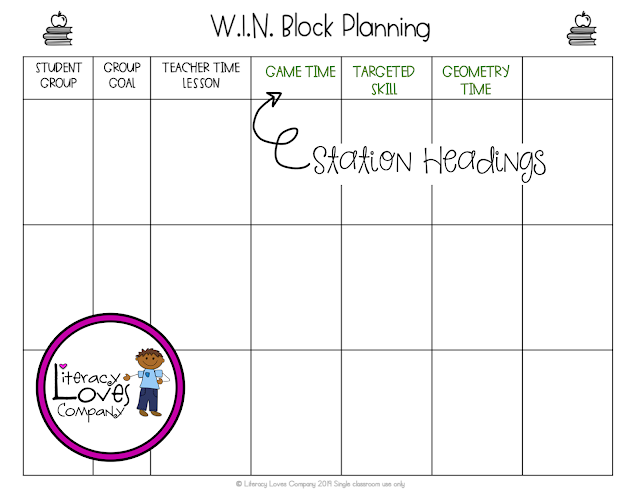
I've used the planning page above for my last couple of W.I.N. rounds. I've revamped it for this blog post and to help me plan my next round.  The new planning pages give you space for your group lists, group goals, group lesson plans, and an opportunity to plan each of your other stations.
Organizing groups for differentiation in the classroom can be daunting.  Literacy Loves Company shares how she manages W.I.N. math stations and creates small groups in her 5th grade math class.


Click below for a free download of the W.I.N. planner.  There are three options:
1.  Fillable PDF
After you open in Google, make sure to "download" it.  


2. Printable PDF

3. PNG to put into a PowerPoint slide and make your own text boxes.  Use this option if you want to be able to change your font, colors, etc.


I hope that this post gives you some ideas of ways you can look at student data to plan small groups for your W.I.N. block.  Next week I will be sharing ideas for W.I.N. math station activities.  Here is a list of upcoming blog posts in this series:

•   Station Ideas - free download of editable station signs and group headers
•   Managing Materials - free download of binder cover and spine
•   Keeping Kids Accountable - free download of student recording sheet
•   Launching a W.I.N. Block - Mystery download! 

If you have any questions about how to form groups please let me know in the comments below.  Also, if you use different assessments or sources of data in your classroom, please share with others by commenting.  I look forward to hearing from you.  

signature-fonts


Thursday, December 29, 2016

Grab 'Em with Guinness World Records

Looking for attention grabbers for writing, math, social studies, and science?  Visit Literacy Loves Company to see how using Guinness World Record can be used for writing inspiration, math centers, and anticipatory sets!  You’ll see Guinness World Records in a whole new way!

As teachers, we've all seen it...  groups of elementary school kids crowded around a dog-eared, well worn copy of Guinness World Records.  Kids are mesmerized by the pictures of the tallest man and the longest fingernails.  They giggle over the flamboyant tattoos and the shocking piercings.  Many dream about being the fastest person, having the most home runs, or any other number of records just waiting to be broken.

Looking for attention grabbers for writing, math, social studies, and science?  Visit Literacy Loves Company to see how using Guinness World Record can be used for writing inspiration, math centers, and anticipatory sets!  You’ll see Guinness World Records in a whole new way!
Guinness World Records is a great way to entertain students, but did you know that is is full of fascinating facts and interesting information that'll peak your class's curiosity and set them up to learn?

If you've ever taken a close look at the inside of Guinness, you've seen it is ripe with possibilities.  So many great ideas, in fact, that the people at Guinness have created a Teachers Guide for the new 2017 edition.

You can use the Teachers Edition with a hard copy of Guinness World Records 2017 (see the end of the post for a giveaway of the book) or the guinnessworldrecords.com.

The lesson plan guide contains activity ideas for grades 2-5 and connect to the Common Core Standards.  Activities include ideas for measurement and mapping, language arts, and science.
Looking for attention grabbers for writing, math, social studies, and science?  Visit Literacy Loves Company to see how using Guinness World Record can be used for writing inspiration, math centers, and anticipatory sets!  You’ll see Guinness World Records in a whole new way!

In my classroom, I used the teachers guide to create a measurement math station.  Students worked with a partner to measure a variety of body parts and then compared their measurements to the record holders.  I've provided the sheet I used HERE as a free download for you.
Looking for attention grabbers for writing, math, social studies, and science?  Visit Literacy Loves Company to see how using Guinness World Record can be used for writing inspiration, math centers, and anticipatory sets!  You’ll see Guinness World Records in a whole new way!
The measurements for the middle section can be found in the Teacher's Edition. 

Looking for attention grabbers for writing, math, social studies, and science?  Visit Literacy Loves Company to see how using Guinness World Record can be used for writing inspiration, math centers, and anticipatory sets!  You’ll see Guinness World Records in a whole new way!

I have to be honest, I always thought that Guinness was just a book full of records, but it is SO MUCH MORE!  It is packed full of interesting facts and information for just about anything you can think of.  As I looked through the 2017 edition I found myself continually thinking about how this book could be used to enhance just about every science and social studies unit I teach in 4th grade!  I'm going to give you a quick pic-tour so you can start thinking about how you could use Guinness in your own classroom.

Looking for attention grabbers for writing, math, social studies, and science?  Visit Literacy Loves Company to see how using Guinness World Record can be used for writing inspiration, math centers, and anticipatory sets!  You’ll see Guinness World Records in a whole new way!

Looking for attention grabbers for writing, math, social studies, and science?  Visit Literacy Loves Company to see how using Guinness World Record can be used for writing inspiration, math centers, and anticipatory sets!  You’ll see Guinness World Records in a whole new way!
If your students learn about space as part of your curriculum, sharing some of the facts in this section would be a great way to peak interest at the beginning of your unit!
Looking for attention grabbers for writing, math, social studies, and science?  Visit Literacy Loves Company to see how using Guinness World Record can be used for writing inspiration, math centers, and anticipatory sets!  You’ll see Guinness World Records in a whole new way!

Looking for attention grabbers for writing, math, social studies, and science?  Visit Literacy Loves Company to see how using Guinness World Record can be used for writing inspiration, math centers, and anticipatory sets!  You’ll see Guinness World Records in a whole new way!
If you study geology, clouds, weather, oceans,  or plant adaptations, this section if packed with fun facts students will love!  
Looking for attention grabbers for writing, math, social studies, and science?  Visit Literacy Loves Company to see how using Guinness World Record can be used for writing inspiration, math centers, and anticipatory sets!  You’ll see Guinness World Records in a whole new way!
 Every kids loves learning about animals!  This section is full of interesting information students will get excited about.  If you teach animal adaptations, habitats, spiders, or dinosaurs this is a great section to find attention-grabbing facts!
Looking for attention grabbers for writing, math, social studies, and science?  Visit Literacy Loves Company to see how using Guinness World Record can be used for writing inspiration, math centers, and anticipatory sets!  You’ll see Guinness World Records in a whole new way!
Another great feature you'll find at the bottom of many of the pages is a time line.  
Looking for attention grabbers for writing, math, social studies, and science?  Visit Literacy Loves Company to see how using Guinness World Record can be used for writing inspiration, math centers, and anticipatory sets!  You’ll see Guinness World Records in a whole new way!

Looking for attention grabbers for writing, math, social studies, and science?  Visit Literacy Loves Company to see how using Guinness World Record can be used for writing inspiration, math centers, and anticipatory sets!  You’ll see Guinness World Records in a whole new way!
This section would be great for teachers starting a unit on body systems! 
 The Journey's section is a wonderful compliment to your study of explorers and explorations.  
Looking for attention grabbers for writing, math, social studies, and science?  Visit Literacy Loves Company to see how using Guinness World Record can be used for writing inspiration, math centers, and anticipatory sets!  You’ll see Guinness World Records in a whole new way!

Looking for attention grabbers for writing, math, social studies, and science?  Visit Literacy Loves Company to see how using Guinness World Record can be used for writing inspiration, math centers, and anticipatory sets!  You’ll see Guinness World Records in a whole new way!
 The "Do Try This at Home..." section is full of fun challenges students can try at home such as how many sugar cubes can you balance on your chin or how fast can you drink a bottle of ketchup.  
Looking for attention grabbers for writing, math, social studies, and science?  Visit Literacy Loves Company to see how using Guinness World Record can be used for writing inspiration, math centers, and anticipatory sets!  You’ll see Guinness World Records in a whole new way!

Looking for attention grabbers for writing, math, social studies, and science?  Visit Literacy Loves Company to see how using Guinness World Record can be used for writing inspiration, math centers, and anticipatory sets!  You’ll see Guinness World Records in a whole new way!
 And some crazy things you DON'T want to try at home or anywhere else! 
Looking for attention grabbers for writing, math, social studies, and science?  Visit Literacy Loves Company to see how using Guinness World Record can be used for writing inspiration, math centers, and anticipatory sets!  You’ll see Guinness World Records in a whole new way!
Add caption

Every kids loves toys and games!  There are some great writing prompt ideas you could get from this section! 
Looking for attention grabbers for writing, math, social studies, and science?  Visit Literacy Loves Company to see how using Guinness World Record can be used for writing inspiration, math centers, and anticipatory sets!  You’ll see Guinness World Records in a whole new way!

Looking for attention grabbers for writing, math, social studies, and science?  Visit Literacy Loves Company to see how using Guinness World Record can be used for writing inspiration, math centers, and anticipatory sets!  You’ll see Guinness World Records in a whole new way!

Looking for attention grabbers for writing, math, social studies, and science?  Visit Literacy Loves Company to see how using Guinness World Record can be used for writing inspiration, math centers, and anticipatory sets!  You’ll see Guinness World Records in a whole new way!
 For students who love to build!  The facts and information inside this section would be a great way to inspire a STEM unit!  There are also a lot of measurements in this section you could use to have students compare and contrast, find the difference, etc.
Looking for attention grabbers for writing, math, social studies, and science?  Visit Literacy Loves Company to see how using Guinness World Record can be used for writing inspiration, math centers, and anticipatory sets!  You’ll see Guinness World Records in a whole new way!
The Arts & Media section is another wonderful section to find ideas for writing.  
Looking for attention grabbers for writing, math, social studies, and science?  Visit Literacy Loves Company to see how using Guinness World Record can be used for writing inspiration, math centers, and anticipatory sets!  You’ll see Guinness World Records in a whole new way!

Looking for attention grabbers for writing, math, social studies, and science?  Visit Literacy Loves Company to see how using Guinness World Record can be used for writing inspiration, math centers, and anticipatory sets!  You’ll see Guinness World Records in a whole new way!
There are so many different possibilities with this section!  Writing prompts and facts to grab learners at the start of a science unit are just a couple.   
Looking for attention grabbers for writing, math, social studies, and science?  Visit Literacy Loves Company to see how using Guinness World Record can be used for writing inspiration, math centers, and anticipatory sets!  You’ll see Guinness World Records in a whole new way!

Looking for attention grabbers for writing, math, social studies, and science?  Visit Literacy Loves Company to see how using Guinness World Record can be used for writing inspiration, math centers, and anticipatory sets!  You’ll see Guinness World Records in a whole new way!
 The sports section is another favorite of students!  
Looking for attention grabbers for writing, math, social studies, and science?  Visit Literacy Loves Company to see how using Guinness World Record can be used for writing inspiration, math centers, and anticipatory sets!  You’ll see Guinness World Records in a whole new way!

Looking for attention grabbers for writing, math, social studies, and science?  Visit Literacy Loves Company to see how using Guinness World Record can be used for writing inspiration, math centers, and anticipatory sets!  You’ll see Guinness World Records in a whole new way!


As you can see, Guinness World Records is a valuable resource for any classroom!  It is not only a favorite of students, but there is a lot of great attention grabbing content inside of this book for teachers to use as a support and enhancement to your grade-level lesson and units!  

Don't forget to download your FREE Teachers Guide by clicking the link above and as a "Thank You" for visiting Literacy Loves Company and reading this blog post, the people at Guinness World Records have given me a copy of the NEW 2017 edition to give to one lucky reader! 

Looking for attention grabbers for writing, math, social studies, and science?  Visit Literacy Loves Company to see how using Guinness World Record can be used for writing inspiration, math centers, and anticipatory sets!  You’ll see Guinness World Records in a whole new way!

GIVEAWAY GUIDELINES:
  • Since, if you win,  I will have to ship the book to you, the giveaway is only open to people with mailing addresses within the continental United States. 
  • The giveaway is open from December 29, 2016 through January 9th, 2016.  
  • I only have one book, so there will only be one lucky winner!
  • To enter, please enter your information in the Rafflecopter widget at the bottom of this post.  
  • The winner will be randomly chosen by the Rafflecopter widget.
  • The winner will be announced Tuesday, January 10th on my Facebook page, Instagram account, here on the blog, and by email. 
  • The winner will need to respond to my email by January 15th with a mailing address so that I can get your book in the mail that next week.  

Looking for attention grabbers for writing, math, social studies, and science?  Visit Literacy Loves Company to see how using Guinness World Record can be used for writing inspiration, math centers, and anticipatory sets!  You’ll see Guinness World Records in a whole new way!


Looking for attention grabbers for writing, math, social studies, and science?  Visit Literacy Loves Company to see how using Guinness World Record can be used for writing inspiration, math centers, and anticipatory sets!  You’ll see Guinness World Records in a whole new way!
Please PIN me. 


Thank you for visiting Literacy Loves Company!  I hope this post has inspired you to take a closer look at your Guinness World Records books for inspiration!

Saturday, January 9, 2016

Finding the Joy in Planning


There's something very comforting in fresh starts.  As a teacher, you get a fresh start each day, each week, and a big fresh start each year.  A chance to start over.  A chance to improve.  A chance to try something different.  

January is another chance for a fresh start.  I consider it the season of fresh starts for my personal life.   A chance to renew goals and set new ones.  This year, I didn't make any "official" new year resolutions.  (To be honest, I was recovering from pneumonia and all I wanted was to stop coughing.)    Instead I have the life goal that I'm always striving for:

Of course that goal isn't as simple as it seems.  There are a lot of "sub-goals" that go with it and the toughest one for me is being organized.

People who know me think I am an organized person.  Maybe I am on the outside, but inside of myself I feel like I am one sticky-note from losing it.  If you took a look at my desks at home and at school you would see stacks, sticky notes, and a dozen different notebooks and notepads.  I've tried planners, journals, electronic schedules.  None of these methods have brought me joy or made me calm.

During winter break, while I was wheezing and hacking my way through another day of Instagram and Pinterest browsing, I came across an intriguing post about Bullet Journals.  It caught my attention and I embarked on a research frenzy.  I watched youtube.com videos, searched hashtags, and stalked blogs (I'll post links at the bottom of the post.)

By the end I was hooked.   Here is why:
1. You can use whatever notebook you want.  No need to buy a $50+ planner system.
2.  It's a planner...  a journal... a sketch book... whatever you want or need it to be.
3.  It's a fairly simple idea.
4.  It's artistic and colorful.
5.  It's everything in one place.

Here is a little pic-tour of my bullet journal as it is at this point:
This Leuchtturm1917 journal was highly recommended for using as a bullet journal.  They come in lined, grid, and dotted.  Most bullet journal enthusiasts suggest using the dotted.  This journal is great!  It comes in a variety of vibrant colors, includes a pre-made index, and has a convenient little pocket on the inside back cover to hold journal goodies.  

I started out using this collection of pens, but noticed that I was having some issues with the ink not drying quickly (You'll be able to see what  I mean in the pictures below.)  After doing some reading, I bought a set of Staedtler pens and a set of Tombow Dual Brush markers.  Both have been working out wonderfully!


This is my "Key".  When I jot things into my bujo (bullet journal) I use these symbols.  
This is my "Year at a Glance" page.  
This page is for daily tasks, thoughts, events, etc.  I've also been adding the weather for the day.
This is the "Habit Tracker" for the month.  I've put things I hope to do daily or weekly.  I haven't yet stepped on the treadmill...  Yikes!  I may have to do that just so I can put a mark on that line.  It is getting pretty obvious!  
This is my "Daily Gratitude" page.  I've seen them done many different ways, but this is how I chose to do it.  I'm trying to jot down at least 2 things I am grateful for each day.  
This is my "TpT Product Idea" page.  The name says it all.  I've added a little quote I saw on instagram posted by MegsNewBoxofCrayons.  
This is my "Wish List" page.  This page is for the things I hope to do or get this year.  
These are my "Future Planning" pages.  This is where I add events that are happening later in the year.  

There are many other pages I am planning on adding.  For example, I am starting to read "The Life-changing Magic of Tidying Up" by Marie Kondo.  I will be adding a page in my bujo for taking notes from the book.

So far, this little journal has brought joy to my life.  I don't feel stressed about keeping it up to date.  JOY! I love getting it out each night with my colored pencils and markers and updating it.  JOY!  I'm excited about finding designs and inspirational quotes to add to the pages.  JOY! and I know exactly where my to-do list is for both school and home! calm.

If you would like to know more about bullet journaling, here are a couple of resources that I found very helpful:

Thank you for stopping by!  Be sure to follow me on Instagram and/or Facebook for more pics of my bullet journal journey as well as classroom ideas and resources!

*****************************************************
New TpT Resources:
Greek and Latin Root Words - PowerPoints Slideshow, posters, interactive notebook pages, hands-on literacy/word work stations!

Math Center:  Converting, adding and subtracting, and multi-step word problems for metric measurement.